
A great talker that follows the process.
The supervisor sits around the live speech-to-speech model. It keeps the call on the right stage, enforces guardrails, decides when tools may run, and handles barge-in and timeouts.
The model talks. The supervisor runs the call.
A raw speech-to-speech model is very good at conversation. It is not built to follow a business process for twenty minutes. Dinodial wraps every live call in one supervisor that holds the process, so the model can focus on the talking.
The supervisor reads one event at a time from the caller, the model, tool results and timers. Its decisions are plain data, so the same logic is unit tested and reused for phone calls, the widget and simulation.
The process lives in the flow, not in a long prompt.
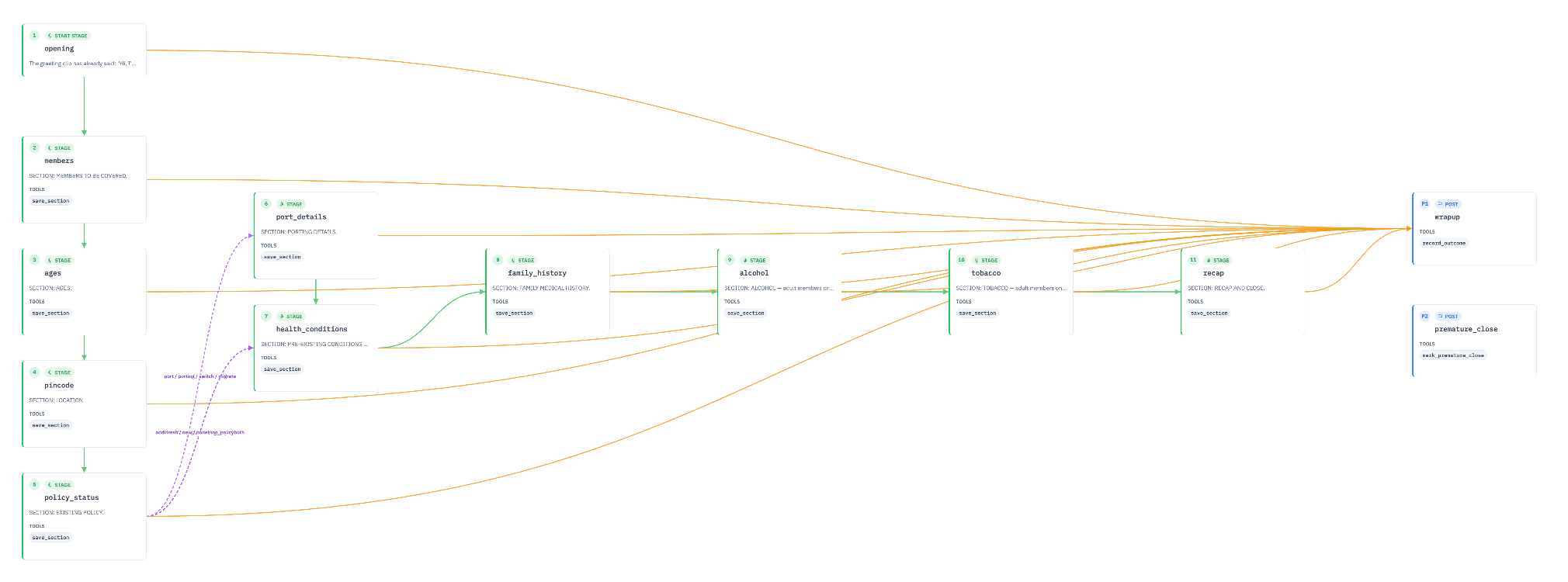
Each stage has its own instruction, the tools it may use, a barge-in setting and its outcomes. This is a real health insurance intake agent: eleven stages, each routing to the next, with wrap-up and premature close handled as separate post steps.
 123
- 1Start stage. The call always opens here, after the greeting clip.
- 2One section per stage. Family history, alcohol, tobacco. The model only sees the job for the stage it is in.
- 3Post steps. Wrap-up records the outcome. Premature close is its own path, so an early hang-up is labelled, not lost.
 12345
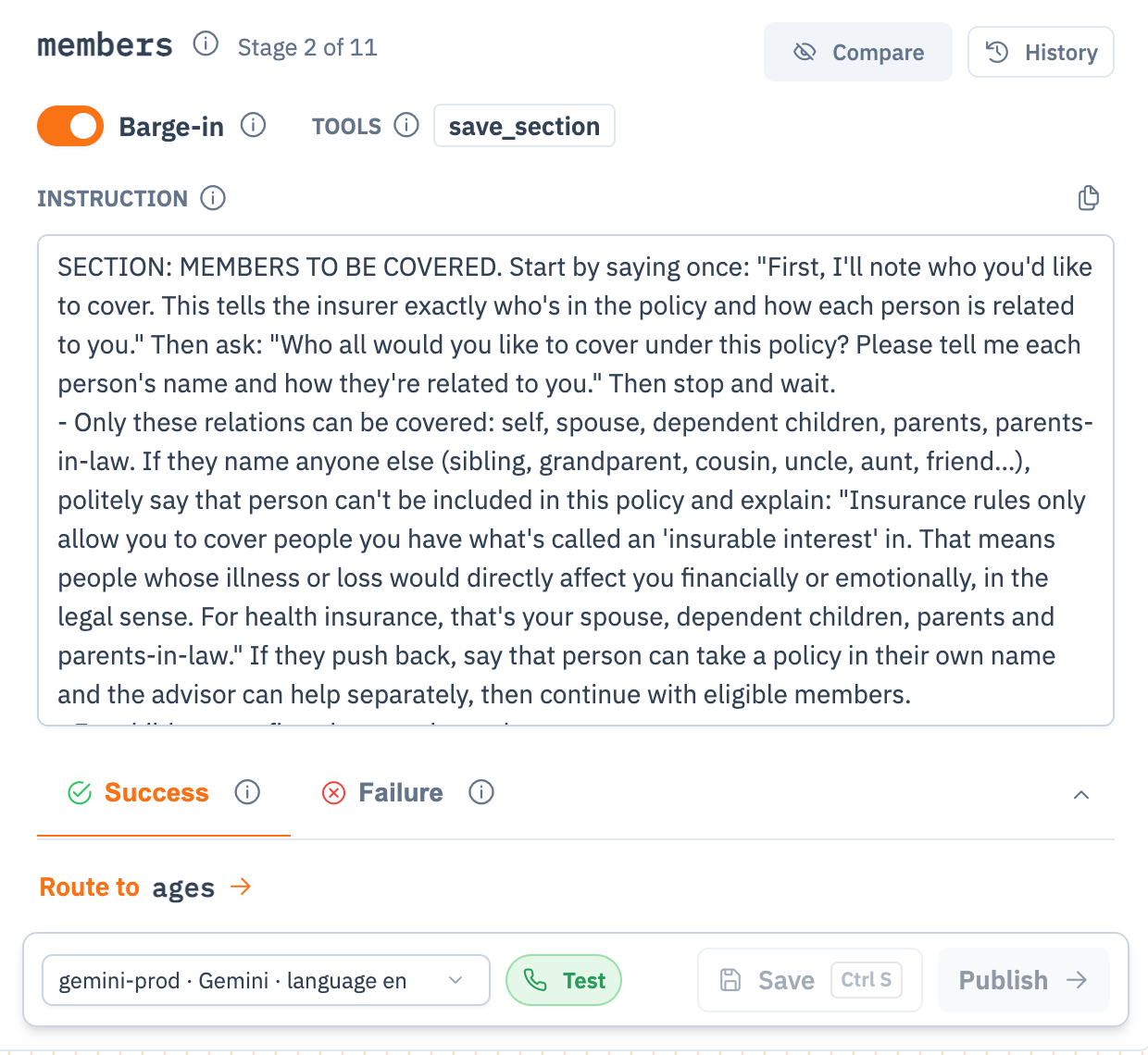
Stage 2 of 11: who is covered.
Business rules sit next to the step they belong to. Here, only relatives with an insurable interest can be added.
- 1Barge-in. Set per stage. Off means a caller cannot cut a required disclosure short.
- 2Allowed tools. Only save_section may run in this stage.
- 3Instruction. What to say, what to ask, and how to handle edge cases, scoped to this step.
- 4Routing. Success moves the call to ages. Failure has its own route.
- 5Test and publish. Test against the draft on gemini-prod before anything goes live.
 1234
The model can ask. The supervisor decides.
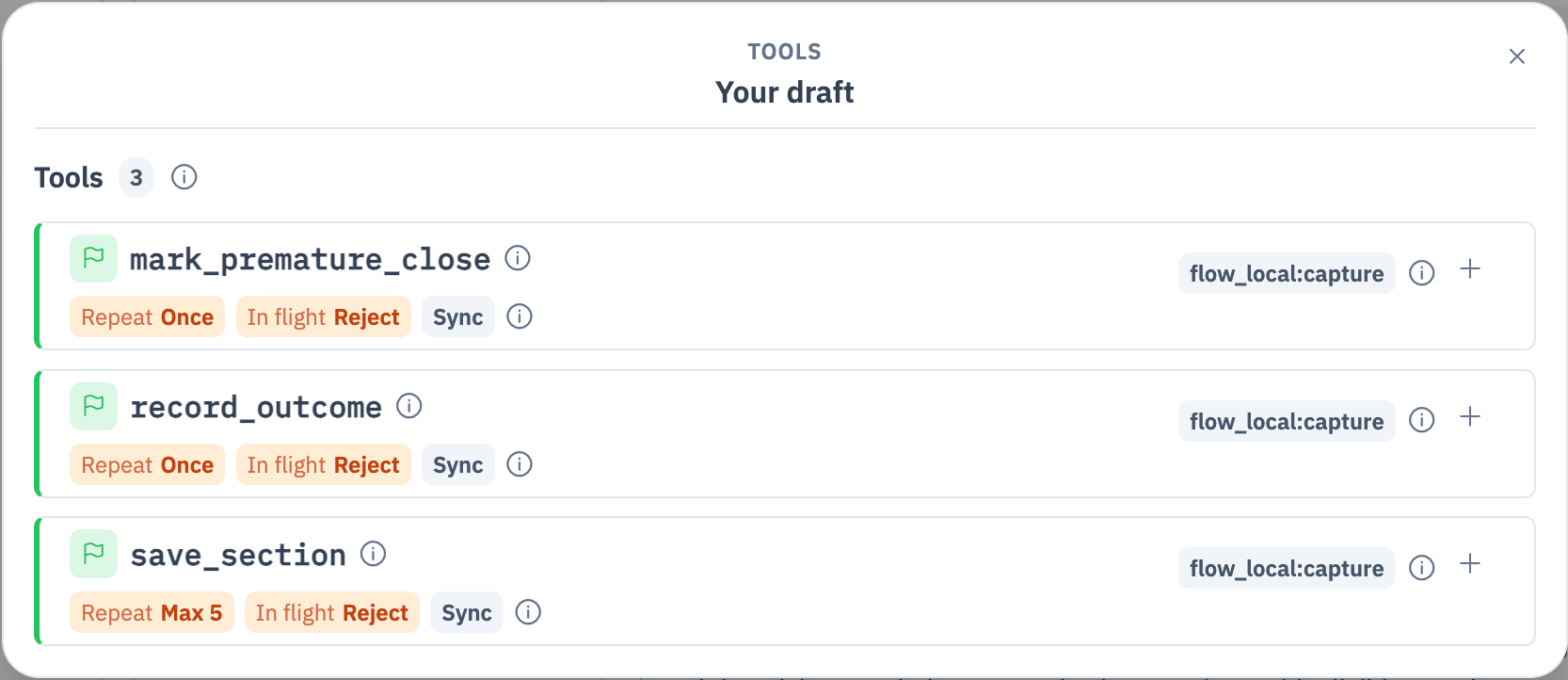
Every tool call passes five checks in order: is it declared, is it allowed in this stage, is one already in flight, has it hit its repeat limit, then dispatch.
- 1Repeat limit. record_outcome runs once. save_section at most five times.
- 2In flight: reject. A second call while the first is still running is refused.
- 3Sync. The model waits for the result before it continues.
- 4Scope. Each tool writes only where it is allowed to.
A rejection never names the stage that would allow the tool, so the model cannot learn to skip a step. Results that arrive after the call has moved on are dropped as stale.
Turn taking and timeouts are rules, not hopes.
One path for every vendor.
When the caller talks over the agent, the vendor reports it and one controller decides whether to clear the audio. A protected reply is not cleared. Lens shows the discarded audio in red.
Prompt, then end cleanly.
After 15 seconds of silence the agent plays an idle prompt. After another 15 seconds with no answer, the call ends as unresponsive instead of hanging open.
Every call holds a lease with a deadline.
If audio never connects (120 seconds on phone, 30 on the widget) or a call runs past its hard limit plus 60 seconds, capacity is freed first and cleanup follows.
Misses escalate.
If the model keeps reporting an outcome the stage does not know, the flow counts misses and, after three by default, routes the call to failure.
Gemini Live does the conversation. Dinodial makes it follow the process.
The script holds for the whole call.
Steps, disclosures and routing live in the flow. A long call does not drift off the process because the model forgot part of a prompt.
Actions happen at the right moment.
A booking, a save or a close can only run in the stage that allows it, a limited number of times, one at a time.
Calls end on purpose.
Silent callers, early hang-ups and stuck calls each end with a labelled outcome, so reports match what really happened.
Fixes are small and safe.
A problem in one step is fixed in that stage, tested against the draft and published as a new version. Nothing else moves.