
Your coding agent can fix the voice agent.
The dino CLI and a hosted MCP server give Claude Code, Gemini CLI and other coding agents access to the server. They read calls, find the failure, suggest a fix, version it, simulate it and publish it, with a human approving each write.
Ask in plain English. Real commands run underneath.
The Dino skills load into Claude Code, Gemini CLI or Codex. The coding agent calls the dino CLI, reads JSON back, and stops for a human yes before anything real happens.
claude · ~/work/health-intake
> Some intake calls are closing early. Find out why and fix it.
⏺ Using the dino-ping and dino-pong skills.

$ dino process list-calls --process-id <id> --limit 50
✓ calls listed · outcomes grouped
$ dino call trace --call-id <id>
  stage members · Rejected record_outcome · Tool was not allowed in the current stage
⏺ The agent tried to close the call in the members stage. The instruction
  does not say what to do when the caller names a sibling. Proposing a fix.

$ dino agent download --agent-id <id> --folder health-intake
  // edit flow.json: stage members, add the insurable-interest rule
$ dino agent validate --agent-dir ./health-intake
{ "ok": true, "cliProtocolVersion": 1, "operation": "agent.validate", "data": {} }

Run one simulation against the simulated caller? It is billable.  Yes / No
> yes
$ dino simulation run … --confirm-mutation simulation.run
✓ completed · Lens reports ready

Publish this draft to Live?  Yes / No
> yes
$ dino agent publish --agent-dir ./health-intake --confirm-mutation agent.publish
✓ merged into Live · new version recorded
Illustrative session. Commands, flags and output shapes are from the dino CLI contract and the live CLI page. IDs are elided.
From a bad call to a published fix, without opening a dashboard.
- 01 · ReadRead calls
Pull calls and traces from the server, the same data Lens shows.
dino process list-calls - 02 · DiagnoseFind the failure
Locate the stage, the turn and the rejected action.
dino call trace - 03 · PatchFix the stage
Edit the prompt or stage in flow.json, then validate.
dino agent validate - 04 · SimulateTest by voice
Run the fix against a simulated caller before any customer hears it.
dino simulation run - 05 · PublishShip a version
A new immutable version merges into Live. The old one stays restorable.
dino agent publish
↻ next batch of calls feeds the next read
 123
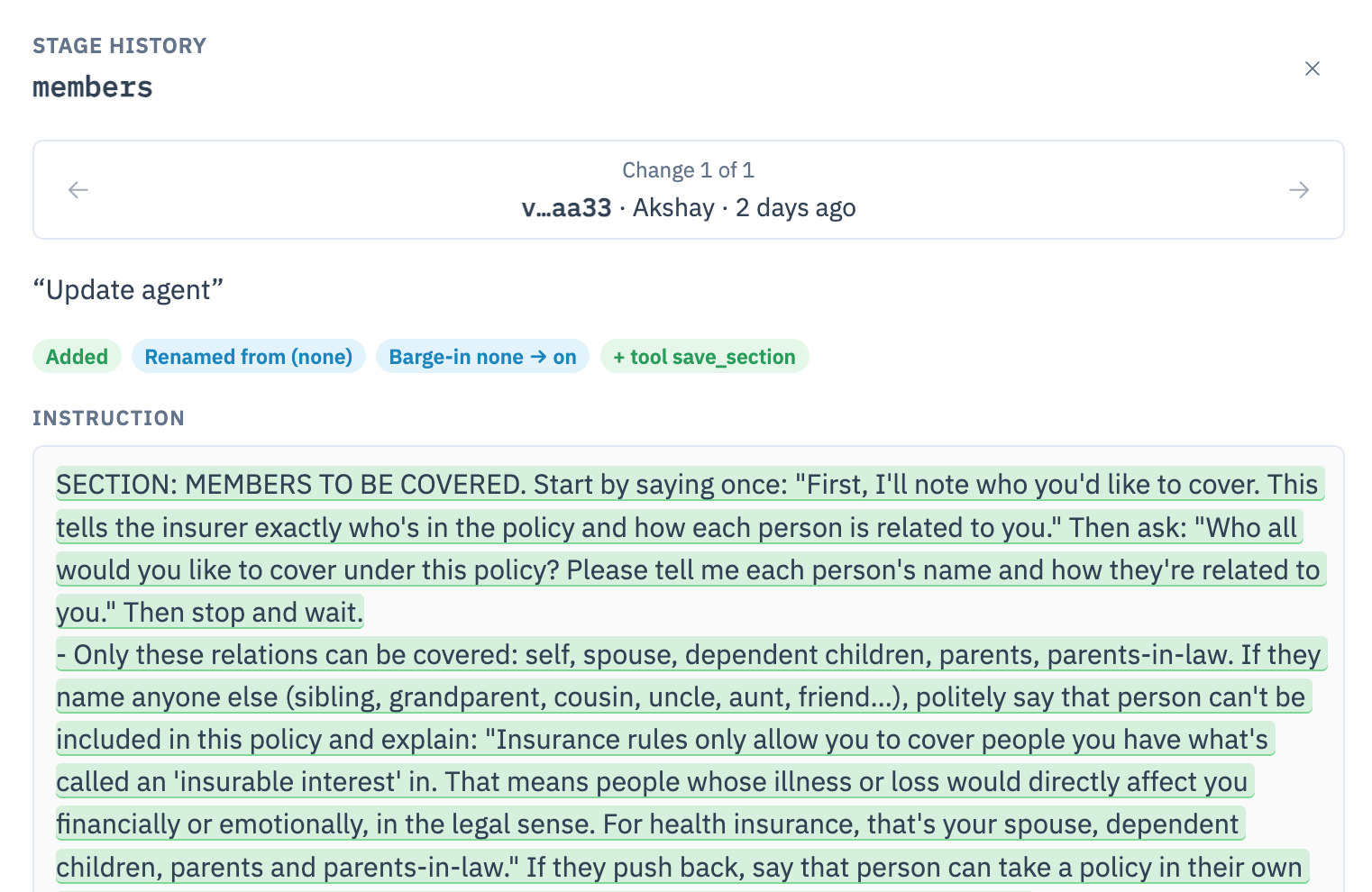
Every agent is a git repository.
Each saved version is an immutable commit. Live and drafts are branches. Nothing is rewritten or deleted.
- 1Who and when. Every change carries its version, author and time.
- 2What changed. Added stage, barge-in turned on, a new tool allowed.
- 3The exact diff. The instruction text that changed, line by line.
Publish is a real git merge of the draft into Live, validated before anything moves. A conflict or an invalid agent is refused. Live never moves backward, and any earlier version can be restored.
CLI for the terminal. MCP for any AI assistant.
dino CLI
- Every command returns one JSON document with a stable error code.
- dino capabilities lists every operation and marks which ones change things.
- Any write needs --confirm-mutation <operation>. Without it, nothing happens.
- Keys live in private files, never in arguments, repos or logs.
Hosted MCP server
- Connects with OAuth through the user's existing Dinodial login.
- A consent page names the app and the data it can read. Access ends after 48 hours.
- Tools are generated from the real API types, so they cannot drift from the platform.
- Same roles and permission checks as a human user. Publish never force-pushes.
The team that builds the agent can keep improving it at coding-agent speed.
Fixes come from real calls.
The coding agent reads the same calls and traces as Lens, so every change starts from evidence, not guesses.
Nothing ships untested.
Validate checks the flow, and a voice simulation runs the fix before a customer hears it.
A human approves every write.
Simulations, publishes and other changes need an exact confirmation for that one operation.
Every version can be rolled back.
Each publish is a commit. Teams see who changed what, and can restore any earlier version.